

PlayBox
The expiry date matters as much as the price.
PlayBox’s supplied review describes credits that expire after 30 days, but gives no exact prices. It also mixes one-time payment claims with annual billing. Those gaps make its cost harder to assess than the feature list suggests.
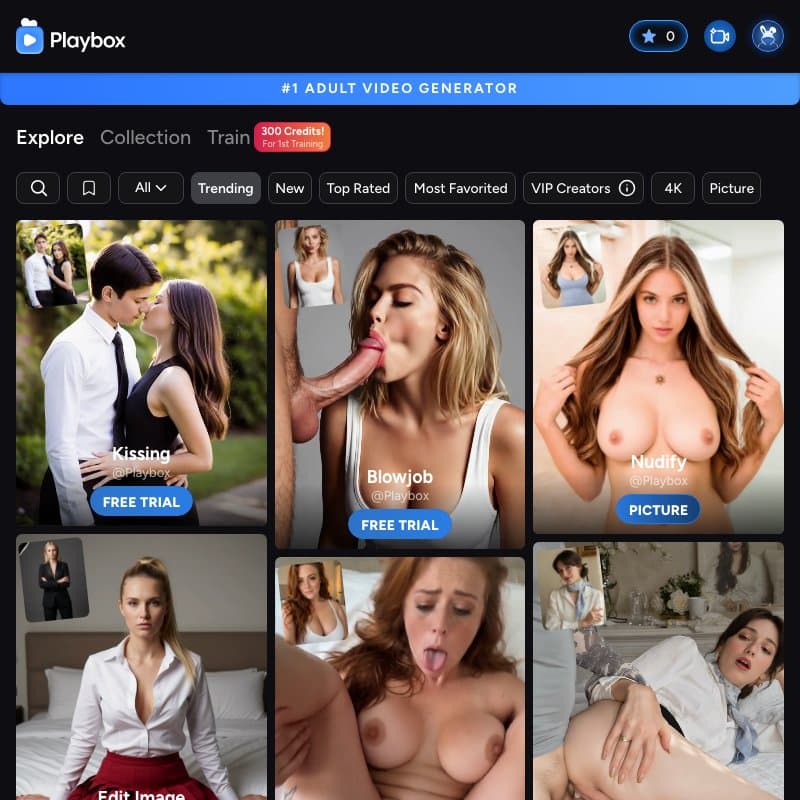
About this review: based on the supplied review text, metadata, and screenshot. No account testing was performed. The material has no capture date, so commercial and policy claims are attributed to that source.
What is PlayBox?
PlayBox is an adult-oriented AI image and video platform with a public gallery and account-based media tools. The supplied screenshot shows Explore, Collection, and Train navigation, along with sorting controls and a credit balance. The written review describes a template-led service with short video outputs and custom model submissions.
The interface is visible evidence; the performance claims are a different matter. The source praises facial consistency and motion quality, but includes no original video files, test conditions, or measurements. A still screenshot cannot establish any of those qualities. This review therefore does not assign a performance score or repeat the source’s claims of superiority over competitors.
What holds up. What’s missing.
Pros
Distinct navigation areas
Explore, Collection, and Train are clearly separated in the supplied screenshot.
Visible sorting controls
The screenshot labels its sorting and filtering controls, making the gallery structure understandable.
Credit balance is visible
The interface shows an account balance in the header, though it does not explain the cost of individual jobs.
Several media paths
The supplied screenshot presents routes for video generation, picture output, nudify, and image editing.
First-training offer is clearly shown
The screenshot advertises 300 credits for a first training run, although eligibility and current availability are not established.
Cons
Reported 30-day expiry
The source says purchased and earned credits expire after 30 days. Unused credit could therefore be lost.
Unclear billing terms
One-time payments and annual billing both appear in the text, without an explanation of how they relate.
Short clips and variable results
The written review describes roughly eight-second outputs and visual errors in complex scenes.
Approval delays are unquantified
The source describes review of custom models, but provides no turnaround times or acceptance criteria.
The limits behind the feature list
Resolution labels are not test results
The source mentions 4K and VIP labels. Neither establishes measured sharpness, frame rate, or the quality of a typical result.
Template dependence
The written review identifies reliance on existing templates as a limitation. It does not document the boundaries of editing control.
Training claims have gaps
The screenshot advertises 300 credits for first training. It does not establish eligibility, current availability, or whether the credits cover a complete job.
Creator income is speculative
The original text speculates about rewards for model creators. No payout schedule or earnings evidence is supplied, so no income claim is made here.
PlayBox pricing: what credits tell you
The clearest financial detail in the source is its claim that all credits expire after 30 days. It applies that statement to purchased credits and those earned through referrals or check-ins. The folder contains no dated policy confirming the rule, so it should not be presented as a verified current term.
The billing model is less clear. The review describes one-time purchases with no recurring subscriptions, then discusses annual billing with monthly allocations. Those arrangements might coexist, but the supplied material does not explain the relationship. It would be misleading to resolve that contradiction by choosing one description and ignoring the other.
There is also no price table, per-job credit schedule, or failed-job credit policy. Without those figures, a cost-per-video estimate or value comparison would be guesswork. The source’s suggested annual savings cannot be checked against actual plan prices.
Free access needs similar care. The screenshot shows free-trial labels on some cards and a separate first-training credit offer. The written review says there is no conventional daily-generation free tier. These observations do not establish a general free allowance or its limits.
What happens to personal images?
A permission rule does not demonstrate enforcement
The supplied review reports an age gate and a prohibition on using real people’s photographs without permission. It does not document how permission is checked, how a depicted person reports misuse, or how quickly a complaint is handled. The existence of a stated rule is insufficient evidence that the safeguard works.
Account deletion has consequences
The source describes permanent account deletion that removes credits, videos, and account data. No deletion test or retention schedule accompanies that claim. It does not establish what happens to backups or material already shared elsewhere.
Refunds and retention remain unanswered
The review mentions linked terms and a privacy policy, but the folder contains no complete policy text. Refund eligibility, storage periods, and access to personal media are not explained in enough detail to assess. Those omissions limit this review’s conclusions; they are not proof of a particular practice by the service.
The verdict on PlayBox
PlayBox’s supplied material describes a substantial set of tools, but the important commercial details are incomplete. Exact prices are missing, trial limits are unclear, and the payment descriptions conflict. The reported 30-day expiry adds a further concern that a simple pack price would not capture.
The original review’s confidence in output quality and creator economics goes beyond its evidence. On the files provided, the defensible conclusion is narrower: the interface is organized, while performance, billing, and data handling need clearer documentation before strong recommendations can be justified.