

DeepUndress
A streamlined workspace with less control than the feature list implies.
DeepUndress groups image transformation, text-to-image, face swap, editing, upscaling, and short video tools into one preset-driven dashboard. It looks approachable, but its undated source leaves pricing and privacy details frustratingly vague.
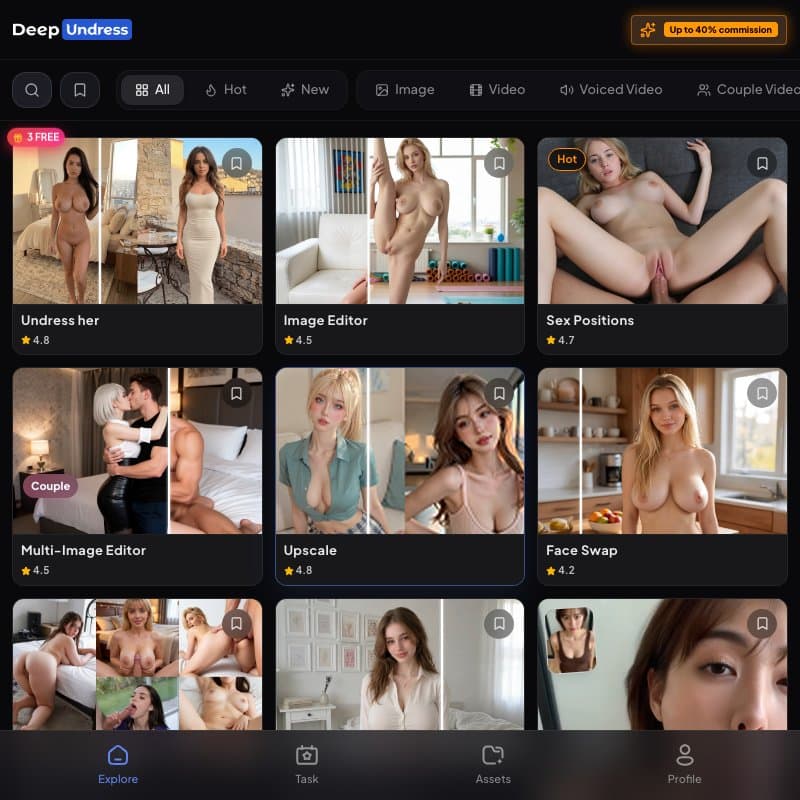
About this review: based only on the supplied written review, metadata, HTML copies, and screenshot. We did not create an account, upload media, or audit the service. The export has no capture date, so pricing, speed, feature access, free credits, and policy claims may have changed.
What is DeepUndress?
DeepUndress is presented as a browser-based adult AI workspace rather than a single transformation tool. The source describes a consistent flow across its dashboard: choose a tool, upload a base image or write a prompt, select a preset, and generate. The supplied screenshot shows that structure clearly, with filters for images, video, voiced video, and couple video alongside cards for editing, upscaling, and face swap.
Simplicity is the main product decision. The review says users do not need to adjust technical generation settings, and visual previews show what a mode is intended to do before credits are spent. That lowers the learning curve, but it also narrows control. Most adjustments are broad presets rather than the detailed parameters an experienced creator might expect.
The source also describes short animations, voiced clips, and multi-person video modes, plus history for revisiting earlier jobs. None of the resulting media is included in the folder. Claims about fast processing, output quality, face consistency, mobile performance, and private handling therefore remain descriptions from the source rather than findings from independent testing.
What holds up. What’s missing.
Pros
The workflow stays consistent
Upload-or-prompt, choose a preset, and generate is described across the image, editing, and video tools.
Several tools share one dashboard
The source groups transformation, text-to-image, face swap, editing, enhancement, upscaling, and motion features together.
Previews appear before generation
Visual thumbnails are described as a way to understand a preset before spending Stars on it.
Generated images can move into editing
The review describes a connected flow from image creation to face swap, enhancement, upscaling, and video without leaving the account.
Browser and mobile access are described
The source says core features run in modern mobile and desktop browsers without specialist hardware or a download.
History supports variations
Past generations are described as accessible from the member area for regeneration or further changes.
Starter credits are mentioned
The source says free signup includes a small balance for trying the workflow, although the amount and current eligibility are missing.
Cons
Input quality drives the result
Poor angles, compression, or unusual poses are said to increase edge blending, anatomy, and texture errors.
Videos are short
The review describes clips of roughly five to eight seconds rather than longer-form scenes.
Exact prices are absent
The source mentions entry plans near $10, VIP tiers, and standalone top-ups without a complete price or Star-cost table.
Fine control is limited
Preset simplicity comes at the cost of detailed sampling, generation, and editing controls.
Free use adds friction
The source describes watermarks and longer queues for free users, with heavier use pushing toward paid access.
Policy claims lack detail
Short retention, refunds, payment methods, ownership, and enforcement are discussed without complete policy text in the folder.
The limits behind the feature list
The screenshot confirms breadth, not results
The interface visibly lists multiple image and video categories, but an 800×800 dashboard capture cannot establish output quality or processing speed.
Text-to-image and editing are linked
The source describes creating a base image, applying face swap or targeted changes, and upscaling inside one workspace. No project history was supplied to verify the sequence.
Motion has the largest tradeoffs
Short video, voiced video, and couple modes are described with higher credit use, longer waits, and more visible warping than still images.
The gallery is a selective showcase
Public categories can clarify the intended styles and modes, but curated thumbnails do not show the failure rate or a typical user result.
DeepUndress pricing: what credits tell you
DeepUndress uses an internal currency called Stars. The source says free registration includes a small starter balance and that free output may be watermarked or placed in a slower queue. It does not state the number of introductory Stars or which tools they cover.
Paid access is described as a mix of VIP subscriptions and standalone Star top-ups. VIP is said to raise limits, speed up queues, remove watermarks, and unlock premium modes. The review mentions entry pricing near $10 per month but provides no exact plan name, billing period, Star allowance, or checkout capture.
Video and voiced modes are described as consuming more Stars than simpler image work, yet no per-tool schedule is supplied. Without that schedule, a monthly headline cannot be translated into a reliable cost per image or clip.
The source also refers cautiously to cards, possible cryptocurrency payments, and restrictive refunds. Because those details are not backed by complete terms, readers should confirm current payment methods, renewal behavior, refund eligibility, Star expiry, and failed-job treatment before paying.
What happens to personal images?
Short retention is asserted, not measured
The review says the terms and privacy policy describe short retention windows. It does not include an exact duration, deletion test, backup policy, or the complete legal language. That is not enough evidence to promise automatic deletion on a specific schedule.
History and deletion need to be reconciled
The same source describes a member history for reopening previous generations. The folder does not explain how long that history remains available, whether deletion is manual or automatic, or how generated files and uploaded source images are treated differently.
Consent rules require enforcement
The material frames the service around synthetic adult fantasy or consenting adult models and reports prohibitions on illegal or non-consensual use. The files do not document age checks beyond account statements, consent verification, reporting response times, or a detailed removal process.
The verdict on DeepUndress
DeepUndress looks best suited to someone who values quick preset choices over deep technical control. Its connected image workflow is sensible: create or upload a base, make targeted changes, apply a face swap, upscale, and move into short motion. The supplied screenshot also suggests a coherent mobile-style navigation system rather than a collection of disconnected landing pages.
The tradeoff is uncertainty. The source acknowledges artifacts on difficult inputs and in complex motion, while withholding the numbers needed to judge value: Star allowances, per-tool costs, failed-generation rules, and exact plan prices. Privacy language is similarly broad. A free starter balance may be enough to inspect the interface, but current checkout and deletion terms should be verified before sensitive uploads or regular spending.